


JasMUN 2026
On September 24, the opening ceremony was held for the latest session of the youth model United Nations conference organized by the 2 SLO community, known as JasMUN 2026 (Jasienica Model United Nations).
Secretary-General Maja opened the conference.
The headteacher Anna Sobala-Zbroszczyk welcomed everyone present and introduced the subject matter of the meeting. She addressed the difficult geopolitical situation in the world, spoke about the need for engagement, and emphasized the importance of upholding the law and preserving peace.
She then invited Aleksander Kwaśniewski, the President of Poland from 1995 to 2005, to take the floor.
Poland is a Success Story
The president began his speech by noting that, although we as human beings are constantly undergoing change, we have never before in history experienced such a dizzying pace of change. He began by drawing audience’s attention to the main trends driving these changes, such as the technological revolution in the form of the internet and artificial intelligence, demographic and climate issues, economic crises, and the development of new forms of weaponry. The world order established after World War II is coming to an end, and it appears that we are returning to a situation in which great powers dominate and their spheres of influence clash on the world stage. This could lead to a final, direct conflict between the major players. The president highlighted several dominant states or political structures in the world: China, the United States of America, Russia—though he characterized it as a purely military power—the European Union, and the so-called Global South, including India. The president mentioned that as early as 2002, he personally heard Vladimir Putin openly express his intention to rebuild a powerful Russia, which currently possesses enormous nuclear and territorial potential as well as great political ambitions. China is emerging as a powerful player in this competition, but due to its different mindset, it is pursuing a strategy of patiently waiting for its opponents to weaken. The methods employed by Donald Trump may also persist in the world after his term ends, although it is to be hoped that new politicians will adopt a more realistic approach. The European Union has economic strength, a high level of education, and advanced social policies and a healthcare system. India, on the other hand, is a hub for the development of modern technology.
Poland fares very well in the context of global politics. From a country that was politically and economically dependent on the Soviet Union, with a centrally planned economic system, it has become a democratic nation with a gross national income five times higher than in 1989. Poland is in good shape, although it is highly polarized politically. The president called for strengthening Poland’s role as a driving force behind European integration, supporting Ukraine, maintaining good relationships with Germany and the United States, and investing in new technologies and the education of engaged citizens who are open to change. Responding to questions from delegates, the president stated that Ukraine, with one of the largest armies in the world, should become a member of NATO in exchange for ceding the Donbas and Crimea to Russia. In closing, the president commented on the UN forum as a place where everyone wants to speak but no one wants to listen, and he highlighted the organization’s diminishing role, noting that it had failed to respond adequately to Russian aggression in Ukraine.
I Wish You Luck
MEP Michał Szczerba also spoke, calling for the creation of a “military Schengen” within the European Union. In the face of threats from hostile nations that could attack EU member states even without a formal declaration of war, it is essential to strengthen European industry, increase defense spending, and secure critical infrastructure. Supporting Ukraine is an investment in European security, and NATO remains its foundation. Having experienced dependence on Russian raw materials, Europe should learn from the past, strengthen its democratic institutions, and foster informed citizens who are resistant to manipulation. The MEP answered questions from the delegates. He assured the audience that media freedom is the cornerstone of the European political system; that despite strong populist trends, Europe manages to maintain unity on decisions critical to its future; that new defense funds are being established, of which Poland will be a beneficiary; and that it is worthwhile focusing on clearly communicating achievements and to build independence and security based on reliable partners.
Let that Be Us
Marta Wierzbicka-Kotte spoke about changes in the world of global politics, reflecting on questions such as who holds power in the world, who is losing it, and what consequences this entails. She presented a broad picture of China’s economic ventures, its dominance in the production of critical raw materials, its involvement in infrastructure development—including in Europe, such as in Piraeus and Hamburg—and its offer of investments to countries that could never have expected the same from the West. She then highlighted the role of the United States of America: the Donald Trump administration put pressure on Denmark regarding Greenland and supports Israel with arms deals worth billions. Russia, for its part, continues its war in Ukraine and is already threatening EU member states. The era of dominance by major players and their power is clearly returning. However, an opportunity lies with the so-called middle-power states, which cannot dominate but can form coalitions, defend security, cooperate economically, protect international law, create bridges for communication, uphold media freedom, and foster an attitude of openness toward differing opinions. Although the global balance of power is clearly shifting, the outcome of this process is unpredictable. Marta Kotte expressed her conviction that coalitions of democratic states are capable of meeting these new challenges and encouraged all delegates to rise to them.
Determined to Be
The coordinator Tomasz Mazur referred to antiquity and to the questions already being asked at that time about who a human being is, what defines them, and what determines their essence. The coordinator noted that one day, those currently ruling the world—who most likely dreamed of creating a better world in their youth—will be replaced by the delegates sitting in the hall. This may present a kind of opportunity, because a person is what they choose to become; they are shaped by their values, and the question of whether they can be certain of achieving their ideals is important to them. The answer lies in the experience of their ancestors. Just as the coordinator, when he was the same age as the delegates, could not have imagined a world with a store featuring an amphibian in its logo or the current level of artificial intelligence, the delegates are likewise unable to imagine what the world will be like 35 years from now. The ancient Greeks believed that the gods determined the personal fate of every human being, and people today may view the influence of large corporations and their policies on their lives in a similar way. In some ways, the fatalism of the ancients resembles the fears of the modern world. The fate of the individual is what it is meant to be. A person strives to achieve goals consistent with their values and is who they are meant to be. Their actions, both destructive and constructive, is a necessary element of history—a part of eternal nature.


(text: Beata Ciacek translated withDeepL.com; photos: Beata Ciacek, Michalina)
Ostatnie aktualności

Anaconda vs. Porcupine
On October 8, Krzysztof Strachota—who, as of January 2025, has been sering as project coordinator for the Center for Eastern Studies: Middle East, a lecturer at the Center for Eastern European Studies (SEW) at the University of Warsaw, a regular contributor to Tygodnik Powsz...

Have No Fear!
On September 18, Aleksander Pohranicznyj, the director of the mission and values of the School of the Free (Wilni) and Concerned in Lviv, along with four students, visited 2 SLO. During the meeting, the director spoke about the school’s day-to-day operations amid a real threa...

Launching on Lake Gil Wielki
The preDP2 students began the new school year with a special trip to the Technical School in Kaletka, where everyone learned new skills and put their teamwork to the test. Together with experienced boatbuilders, they built as many as three Canadian canoes, which were then lau...
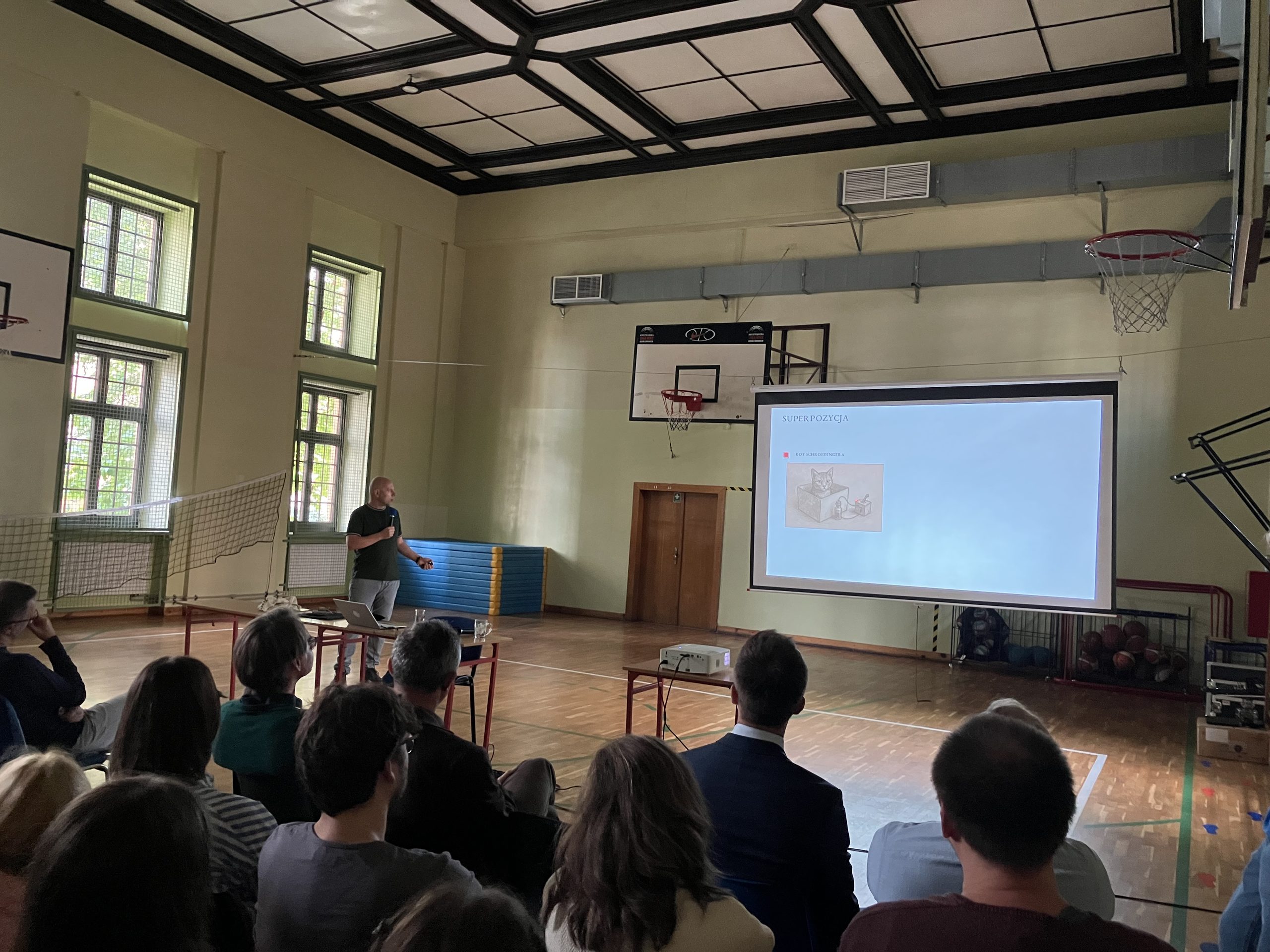
Schrödinger’s Cat: On the Paradox and Its Consequences
The ceremonial start of the school year began with remarks by the headteacher Anna Sobala-Zbroszczyk, as quoted by the coordinator Tomasz Mazur. The headteacher wished the entire school community hope, a good year, and many pleasant moments shared together. Emphasizing the ne...
